The world as I see it.

Thoughts on a variety of topics.

Courage: Born with or learned?

21/02/2011

I received a number of positive comments after my posting on the importance of courage.  Thank you to everyone who commented.


One person observed that not everyone is endowed with courage and asked if it is learned or innate?  Are we born with courage or is it learned?


My immediate reaction was “What a great question for the philosophy section of the French baccalaureate exam!”*


But what about it?  Is courage learned or are we born with it?


In my opinion, we are not born with courage.  We are primarily born with our instincts and one of the most basic instincts is survival.  Survival means seeking safety and avoiding conflict.  We also have an instinct to defend our family and clan but this is still from an aspect of safety and survival.


Courage means the willingness to accept risk and danger to ourselves for a higher cause.  Related is altruism the willingness to sacrifice self for others.  Both are values and values are something that we learn.


No, we are not born with courage.  We learn it.  Not all of us learn courage to the same extent.


You may not agree with me but,   That is how I see things.


Mark Louis Uhrich

Maisons-Laffitte, France,  21 February 2011

©Copyright Mark Uhrich 


*The series of standardized national exams taken by French students at the end of their high school studies.  They establish that the student has successfully ended their studies and serve as the entrance exams for university level studies.  In the US, there is not such a standardized exam on a national level and the “College Board” exams have been developed to serve the same purpose. 

The Importance of Courage

07/02/2011

The events in Tunisia, Egypt, and elsewhere help to illustrate the importance of courage.  People have stood up and have spoken out despite repression and personal risk to themselves.  They have had the courage to take action.  And, with that, they are achieving real change that will benefit themselves and their society.


Through history, we see many examples of people who had courage and those who chose to stay “safe” to not see what was really happening, and who did not take action.


In Nazi Germany and collaborationist France, people knew that things were happening.  But, they chose to stay “safe” to see nothing, to say nothing, to do nothing.  It was too disturbing – too risky.  We know the terrible consequences.


But not everyone ignored the situation.  Many people did have the courage to take action – despite risk.  Many people quietly helped save Jews and others.  Many people fought in the French resistance and thus helped liberate France.


In 1936, German Pastor Martin Niemöller had the courage to speak out against the Nazi government – at great risk to himself and with subsequent imprisonment.


There are many more examples in other countries and in other times. 


The same occurs in organizations.  People know what is happening and some people have the courage to speak out while others chose the “safe” route of silence.  


This even happens in families – the refusal to acknowledge what is and the lack of courage to do what must be done.


When we are not able, or not willing, to see what is and when we prefer to avoid conflict or risk and prefer to stay “safe”, we, in fact, put ourselves in prison.  


But when we are willing to see what is and have the courage to take action, we become free.


That is why courage is important.


You may not agree with me but,   That is how I see things.


Mark Louis Uhrich

Maisons-Laffitte, France,  7 February 2011

©Copyright Mark Uhrich 


(First delivered 7 February 2011 in Paris   a simulated television editorial at the Paris Speech Masters club of Toastmasters International.)

Swans on the Driving Range

21/01/2011

This is the wet season in northern Europe. 


Here in France there has been a lot of snow and rain. This has brought flooding in some areas – especially in the north of France where there has been serious flooding. In Paris, the Seine river has risen and the expressways on the side of the river are closed – under water. This happens almost every year for at least a few days. Occasionally, the flooding can be quite serious. The Great Flood of 1910 flooded good parts of Paris. Since then, an elaborate flood control system has been constructed.


But, on a much lighter note …


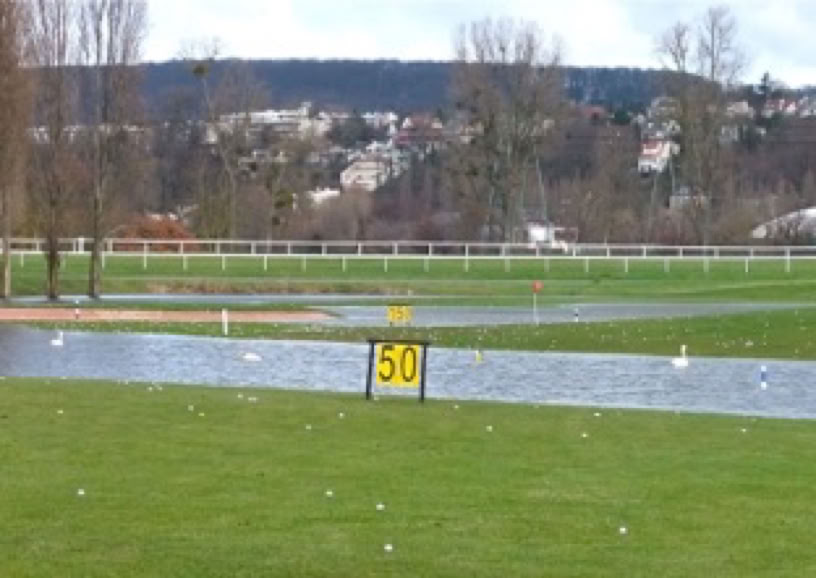
I went to the golf course and found a lake in the middle of the driving range. In addition to sea gulls, a family of swans had taken up residence.


Our golf course here in Maisons-Laffitte is in the middle of a large race track that is located in the floodplain on the edge of the Seine River as the river winds its way from Paris to Le Havre. The area is protected by earthen dikes and, normally, things are dry. However, in this case, it is the ground water table that is rising. Our lake in the driving range has risen to the level of the river.


This is causing some “technical” problems. The golf course is running out of balls. People have been targeting the lake and much of the club’s stock of balls is resting at the bottom of the lake. The course itself is still playable but some new water hazards have formed. If things get worse, they will have to close the course. (The club house is constructed to float.)


Things are starting to improve. The water level is slowly going down and the driving range may be back to its usual dry condition in a few weeks. Meanwhile, the lake and its temporary residents are still there.


And, on the subject of the swans in the driving range lake, I wonder if one gets extra points if ...


You may not agree with me but, That is how I see things.


Mark Louis Uhrich

Maisons-Laffitte, France, 21 January 2011

©Copyright Mark Uhrich 


What all the Noise is About

02/11/2010

There has been for many years an elephant in the living room of the French society. No one has wanted to acknowledge it. No one has had the political courage to challenge it.

That elephant is the retirement system in France and, especially, the retirement age.

The retirement system in France (as in many countries) is based on the principle of “repartition” - meaning that the retirement benefits that people receive is paid for by the retirement contributions of the working population. The system is somewhat complex – as it is in most countries. There are different retirement systems for different workers; general salaried workers, public service workers, independent professionals, and more. 

But to make simple, the retirement systems have two main components:

        1.The basic retirement system - generally under the social security administration. There is a minimum age at which one can start to receive benefits – if they have had the required number of working quarters. (The system counts quarters.) There is an age that one is entitled to full retirement, even if they have not worked enough quarters. The system is funded by salary taxes paid by both the employee and the employer.

        That should sound familiar.

        2.Complimentary mutual retirement programs – obligatory – that people also pay into, again as part of the salary tax.

So far so good, you are saying. But, you ask, what is the retirement age?

“Ay, there's the rub.” (Hamlet 3/1) 


In 1982, under the socialist government of then President François Mitterand, the retirement age was lowered – to 60 years as the age where one could begin to collect retirement if they had worked enough quarters and 65 years as the age where one was entitled to full retirement even if they had not worked enough quarters.

But, things have changed since then – both the economics and the demographics. 

When the retirement age was lowered, there was essentially full employment and most people worked in jobs in the manufacturing sector. Today, as in many countries, many of the manufacturing jobs have been moved to low cost labor countries and the unemployment rate stays stuck at just under 10%.

When the retirement age was lowered, people did not live as long. (And thus, the number of years receiving retirement benefits was much fewer.) Today, people live much longer. Based on my family history, there is a good risk that I may live to the age of 100. What this means is that if I had to work 40 years to earn my retirement and I retire at the age of 60, I will receive retirement benefits for 40 years. You do the math.

People are living longer and there are more and more of us “seniors”. We are rapidly moving to the point where each working person will have to carry on their back the cost on one retired person.

I am looking for that one working person who will carry me on their back for the rest of my life. Will you?

The result of all of this is that the French government is increasingly needing to borrow money to fund the retirement system.

What to do? There are several options. One could further increase the government deficit – but the deficit is already unsustainably high and exceeds the legal limit for the EU. One could further increase taxes – in a country where the tax burden is already very high and where the government promised to reduce taxes. One could reduce retirement benefits – but I will let you imagine the political impact of that. Or, one could recognize the fact that people live longer and are capable of working longer.

Thus, the government proposed a reform of the retirement system where the age of retirement would be raised (on a phased basis) from 60/65 to 62/67. This mirrors what other countries have already done. (Nobody has had the courage to say that it will need to be further increased in the future. But, that is after the next election in 2012.)

And, with this, the noise.

The unions have largely refused to consider any change. The consider the retirement age of 60/65 to be a workers right that was earned and that can not be modified. This rigidity has been aggravated by the government's heavy handed manner to force through the reform without sufficient dialogue. The result is a rupture of dialogue – and the conflict that we see.

The Socialists, who are out of power, do not have any proposal on how to fix the retirement problem but are happy to jump on anything to score points against the conservative government in power. The only proposition was by Ségolène Royal (past Socialist candidate for President) who proposed to further tax the “rich” and the company owners – an economic neutron bomb.

And with that, we have an environment of conflict and people take to the streets. The marches of demonstrators have been well organized by the unions and have been joined by students and politicians from the left – the Socialists, the far left, and the very far left. For the leaders of the minority parties, it is an opportunity to gain visibility and gain points by appearing to be on the side of workers.


But what about the students? Why are they involved?

The students do have legitimate complaints. When they complete their studies, many find that there are not jobs for them. The French economic and cultural systems do not facilitate the entry of new graduates into professional careers. The government promised to correct that problem and has not. The problem is so serious that there are suggestions that there needs to be instituted quotas requiring companies to hire a minimum number of new graduates – something like the equal opportunity quotas that we saw in the United States. (I remember carefully managing my quota numbers as a manager.)

However, an interesting thing is that many of the demonstrating students are not university students. They are high school students. Furthermore, when interviewed on TV, they give a standardized rhetoric and recite an old socialist view that the number of jobs is a fixed pie that needs to be divided up and that making older people work two years longer takes jobs away from new graduates. In this regard, it is my opinion that the students are being manipulated by their frequently highly unionized teachers.

The real issue here is not a fixed pie of jobs but getting sufficient growth in the economic system to provide for job creation.

As Eleanor Beardsleyobserved (NPR 24 Oct 10), student protest demonstrations is a time honored tradition in France. Many of the parents of these students participated in the student revolt of May '68. 


Add to this a level of support from the general French population. While being unhappy with strikes and disruptions many are fed-up with the unfulfilled promises and style of President Sarkozy. Their sentiment is not support of the strikes but against the President and his government.


And, the violence?

We have all seen it on television – the violence in certain cities (notably Lyon) and the burning automobile in Nanterre. While any property destruction is not good, especially for the person who's property is being destroyed, the violence is rather limited. However, the non-stop coverage on television and in the newspapers gives the appearance of generalized chaos.

Unfortunately, in France, as in most all countries, there is an element of hooliganism – people who seek any opportunity to cause destruction. Some of them are arrested but many are minors, some as young as 12-13, and the courts let them go. The hooligans have nothing to do with the question - neither the retirement age nor the complaints of the students.


All this has given us a veritable symphony of calliopes.


As I complete this, the retirement reform has been voted, approved, and will be implemented. The strikes and disruptions have (almost all) ended. The demonstrations are fewer and fewer. But is it over?


That is how I see things.


We still do need to talk about the reason for this conflict and managing strategic change, French style.


Mark Louis Uhrich

Maisons-Laffitte, France, 2 November 2010

©Copyright Mark Uhrich 


Strikes turn to Guerrilla Warfare

23/10/2010

In principle, the strikes of last Tuesday have ended – except in a few cases where the workers voted to have open ended strikes. Some workers continued on strike on Wednesday (and beyond). For example, my flight from Paris to Nice was delayed by about two and a half hours because the continued strike by some of the air traffic controllers caused limitations in take-off slots at Orly airport for domestic flights.


Things are getting back to normal. The Paris metro is largely normal in its operation. Some of the Paris suburban lines are still on partial strike with as low as 50% service. Some have returned to full service. The national rail system is more slowly coming back to normal. The majority of trains are running. (50-90% depending on the line.)


But.


Strikes have turned to guerilla warfare by the unions against the government. Rather than the predeclared strikes, the unions are engaging in sudden unannounced actions to disrupt things. For example, there have been blockades of roads leading to airports – until the police clear them out. There have been groups of people demonstrating on the train tracks and blocking commuter rail traffic – until the police clear them out. Etc., etc., etc.


The biggest problem has been the strikes and blockades at the petroleum refineries and distribution depots – as well covered on television. The majority of the refineries have been closed because of strikes and a large number of distribution depots blockaded by demonstrators. The result is that some quarter of the country filling stations have run dry – a higher percentage in some regions. The refineries are very highly unionized – even more than the rail system. Shutting down the petroleum system is a strategy to put pressure on the government – especially at the beginning of the fall school vacations when many families will be wanting to go away on vacation. 


But the impact is also very severe on the French economy. After days of waiting, the government took action by using its emergency powers to requisition a major refinery in the Paris region and its workers – ordering them back to work. Seen on television in the morning, the union leader at the refinery was clearly very angry. The union went to court and had the requisition order cancelled (The right to strike is in the French constitution.) and the government has issued a more limited and focused requisition order. The arm wrestling continues.


The danger in all of this is radicalization and increased confrontation. Some of the union groups tend to be more radical and there is the risk that the national management of the unions could lo longer be able to keep control of the actions of some of its members. For example, the petroleum sector is highly unionized and the members of those locals tend to be more radical.


By their actions, the relatively small percentage of French workers who are union activists are taking hostage the French public by their actions. The economic loss for the country is considerable.


One wonders how long the French public will tolerate the strikes and blockages. An interesting contradiction is that while most people who I speak with are fed up with the unions and their actions, a small majority of the public supports the need for the union actions. This means that while the public is fed up with the strikes and disruptions, they are even more fed up with this government of President Sarkozy – his methods, his style, and his not keeping his promises that got him elected.


I have been in Nice for several days. Other than my flight delay leaving Paris Orly on Wednesday, things have been calm. As I complete this, my flight from Nice to Paris is shown as being on time.


Things are coming back to normal but the risk of deterioration is there. We do 'live in interesting times'.


That is how I see things.


We still do need to talk about the reason for this conflict and managing strategic change, French style.


Mark Louis Uhrich

Nice, France, 23 October 2010

©Copyright Mark Uhrich